Core Muscles Activated by Seated Leg Curl
The seated leg curl primarily activates the hamstring complex, composed of the biceps femoris, semitendinosus and semimembranosus. These muscles drive the entire movement, contracting concentrically during upward knee flexion and eccentrically during slow knee extension — a key process for muscle growth and endurance. Secondary muscles assist the movement: the calf gastrocnemius supports force output and lower leg stability, while minor glute engagement fixes hip position. This targeted activation minimizes quadriceps involvement, effectively balancing front and rear thigh muscle development.
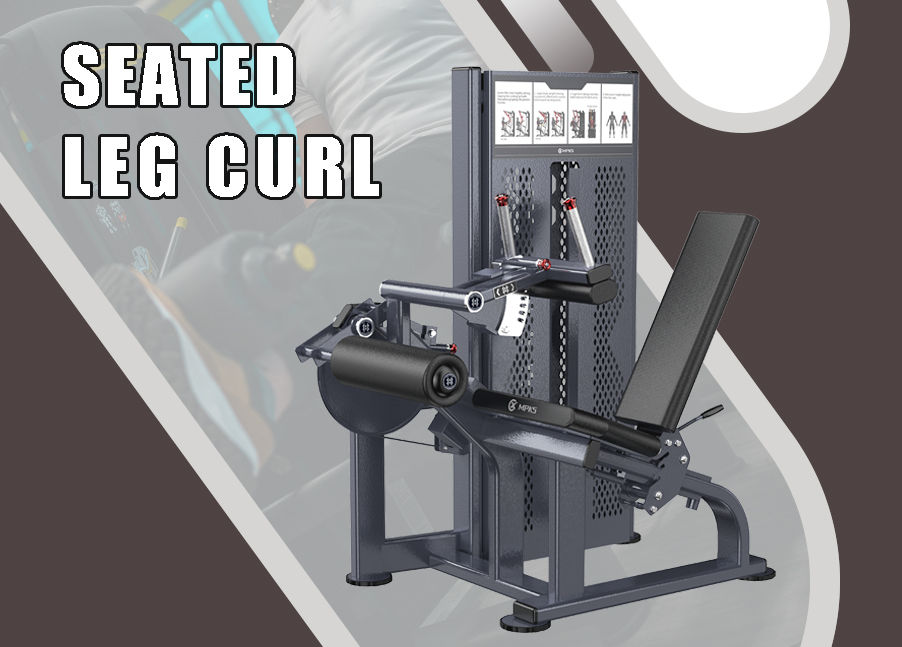
Unique Benefits of Machine Based Seated Leg Curl
The seated leg curl machine’s greatest strengths are its superior stability and training safety. Its fixed track eliminates irregular body movement, lowering injury risks common in free-weight hamstring workouts, and offers a standardized training environment ideal for beginners to build correct muscle awareness. It delivers precise isolated training to compensate for insufficient posterior thigh stimulation from quad-dominant compound leg exercises, improving lower-body muscle symmetry. Additionally, its adjustable weight supports progressive overload for all training stages, and the seated posture reduces lumbar compression, suiting trainees with mild back discomfort.
Standard Movement Techniques and Training Tips
Standard form is critical for effective and safe seated leg curl training. Prior to exercise, adjust the seat to align hips and knees naturally, press your back firmly against the backrest, and secure your insteps under the weight pad with knees near the machine’s pivot. Keep your torso fixed and grip the handles steadily throughout the movement. Slowly flex your knees to pull the pad upward, hold the peak contraction for 1–2 seconds to squeeze hamstrings, then lower the weight slowly without inertial movement. For training plans, beginners use light weights with 12–15 reps per set to build force sense, while advanced trainees adopt moderate-heavy weights with 8–12 reps for muscle hypertrophy. Pairing this exercise with quad workouts avoids muscle imbalance and optimizes leg training results.


